


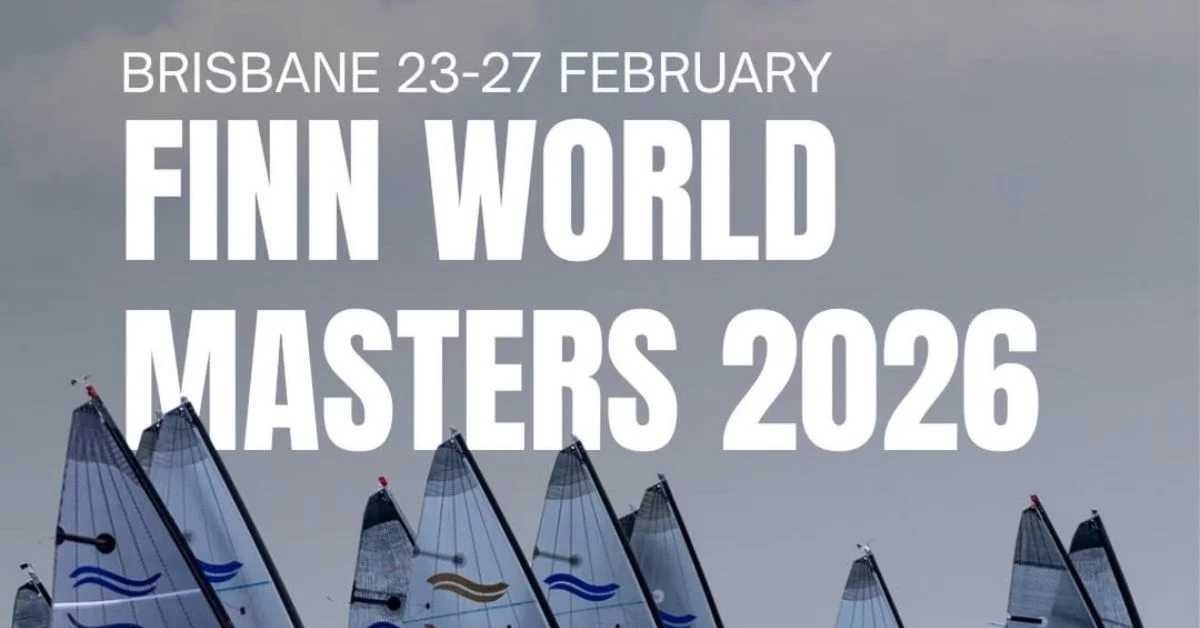
Sailors from 18 nations have gathered at the Royal Queensland Yacht Squadron in Manly for the 56th Finn World Masters, one of the most prestigious titles in single-handed dinghy racing, with eight races scheduled across five days on the waters of Waterloo Bay.
Just over 100 competitors registered for the Porsche Centre Brisbane 2026 event, which opened at the RQYS on Sunday evening with a ceremony on the club’s lawn. The Masters follows immediately after the 70th Finn Gold Cup, also held at RQYS, making this the third back-to-back Finn event hosted by the Manly club across a remarkable fortnight of international sailing. For residents of Manly and the surrounding Moreton Bay foreshore, the precinct has been alive with the sound and spectacle of world-class dinghy racing since mid-February.
A Dinghy With Olympic Roots and a Global Following
The Finn is one of the most storied classes in sailing history. Designed by Swedish canoe builder Rickard Sarby in 1949, the Finn made its Olympic debut at the 1952 Helsinki Games and featured in every summer Olympics until Tokyo 2020, making it the longest-serving dinghy in the Olympic regatta. Despite its removal from the Paris 2024 programme, the class has not merely survived its post-Olympic era, it has flourished. The Finn Masters circuit is now one of the largest sailing organisations in the world, with hundreds of boats competing in world championships, proving the boat’s appeal stretches well beyond the Olympic rings.
What draws sailors to the Finn, and keeps them there, is the sheer physical and tactical demand the boat places on its crew. With a hull weight of 107 kilograms, the Finn requires sailors to work harder than perhaps any other dinghy class, with downwind legs in stronger winds becoming an anaerobic sprint where heart rates spike to near-maximum levels for extended periods. It is, in short, the kind of boat that earns deep loyalty from the people who sail it.
A Brisbane Coup Years in the Making
The decision to bring both the Finn Gold Cup and the Finn World Masters to Brisbane in the same fortnight was deliberate. Conversations between the International Finn Association, the International Finn Association Australia and RQYS began as far back as 2016, with considerable effort required to convince the global Finn community that sending both major championships to one city was a sound idea. It came together, and the club’s response has validated that confidence: roughly half of the Masters fleet has travelled from outside the region, representing 18 nations across Europe, the Americas and Asia-Pacific.
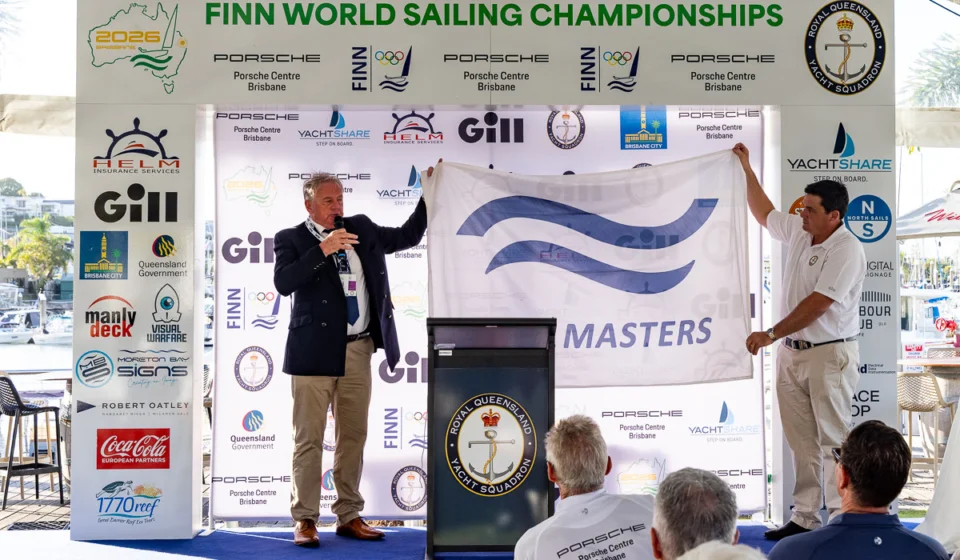
The opening ceremony saw Finn Masters President Andy Denison formally welcome the fleet and receive the Masters Gold Cup from German sailor Thomas Schmid, representing last year’s champion Pieter-Jan Postma, who is absent to defend his title. Denison then presented the Finn Masters flag to RQYS Commodore Curtis Skinner before officially declaring the championship open.
Who to Watch on Waterloo Bay
The Masters fleet includes several standout names from the Finn Gold Cup held at the same venue the week prior. Australian Brendan Casey, who claimed bronze at the Gold Cup and was nearly unbeatable when conditions turned light, returns for the Masters alongside compatriots Anthony Nossiter and Rob McMillan. Spain’s Rafael Trujillo, a Finn Class Hall of Fame inductee and the only previous Masters winner in this week’s fleet (having won in 2016), is another to watch, as is New Zealand’s Karl Purdie.
World ranked number one Laurent Hay of France, whose Gold Cup campaign was hampered by equipment problems, will be looking to reset, while Britain’s Nick Craig is expected to benefit from the flatter conditions inside Waterloo Bay. Swedish sailor Peter Overup, ranked tenth in the world, rounds out a formidable top-of-fleet group.
Racing conditions inside Waterloo Bay differ meaningfully from the open Moreton Bay waters used for the Gold Cup, with flatter water, changeable currents and more pronounced wind shifts all expected to play a role across the eight scheduled races.
Racing Schedule and How to Follow Along
Racing runs from Monday 23 February through to Friday 27 February, with the first start each day at 1:00pm. The Royal Queensland Yacht Squadron is located at 578 Royal Esplanade, Manly. Spectators are welcome at the club, and live results and coverage are available through the International Finn Association website at finnclass.org.
Published 23-February-2026.


